
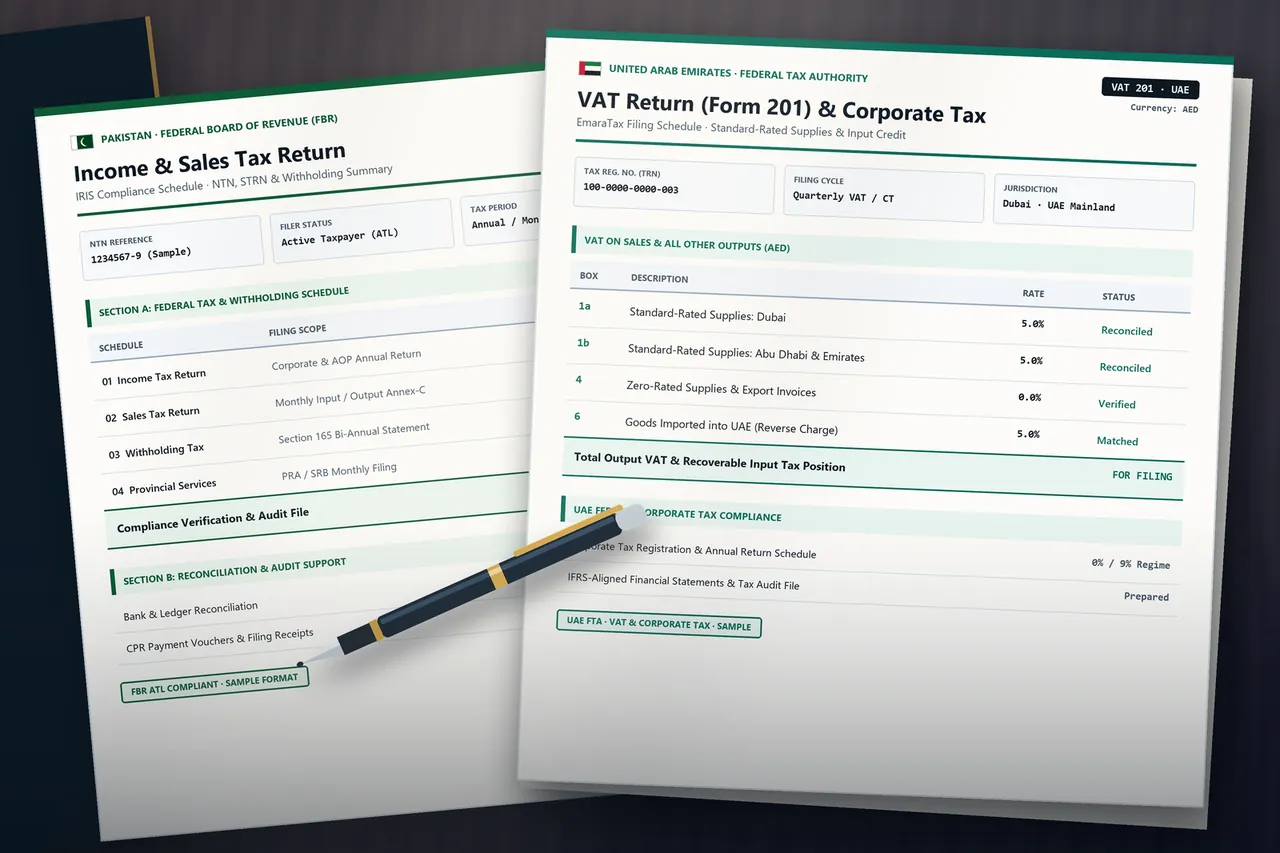
Businesses operating in the United Arab Emirates, in Pakistan, or across both countries face different tax calendars, portals and documentation rules. Most late-filing penalties happen not because the tax itself is disputed, but because purchase invoices, withholding certificates or bank reconciliations are gathered days before the portal closes.
1. UAE VAT (FTA Form 201)
Once registered for UAE VAT on EmaraTax, returns and payment fall due on the 28th day following the end of each tax period (monthly or staggered quarterly, as printed on your VAT registration certificate).
Before each return closes, confirm that:
- every standard-rated supply carries a compliant tax invoice showing the customer TRN where applicable;
- zero-rated exports hold customs exit certificates and shipping documents;
- input VAT is claimed only where a valid supplier tax invoice has been received and paid or scheduled within six months;
- reverse-charge imports of services and goods match customs declarations linked to your TRN.
2. UAE Corporate Tax (0% and 9% tiers)
Under the federal Corporate Tax regime, taxable income up to AED 375,000 is taxed at 0% and taxable income above that threshold is taxed at 9%. Registration on EmaraTax is mandatory even when a company expects zero tax payable, and the annual return plus payment fall due within nine months of the financial year end.
Two checks matter early in the year:
- Small Business Relief and Qualifying Free Zone Person elections have revenue thresholds, substance rules and audit requirements that cannot be improvised after year end.
- Related-party transactions, owner salaries and personal expenses running through company accounts must be documented at arm’s length and separated cleanly in the general ledger.
3. Pakistan FBR sales tax, withholding and income tax
In Pakistan, monthly sales tax returns require supplier Annex-A and customer Annex-C matching on FBR IRIS, with payment due by the 15th and return submission by the 18th of the following month. Quarterly withholding statements under Section 165 follow on the 20th of April, July, October and January.
Common avoidable issues include:
- paying unregistered or inactive suppliers without checking Active Taxpayer List (ATL) status first, which changes withholding rates and blocks input adjustment;
- leaving bank reconciliations until September or December when annual income tax returns fall due;
- overlooking provincial services sales tax registrations (PRA in Punjab, SRB in Sindh, KPRA or BRA) when billing services alongside goods.
Keep one filing calendar
You can build your twelve-month schedule and export .ics reminders on our UAE & Pakistan tax filing calendar, or hand the monthly books and filings to one team so returns are prepared straight from reconciled ledgers.